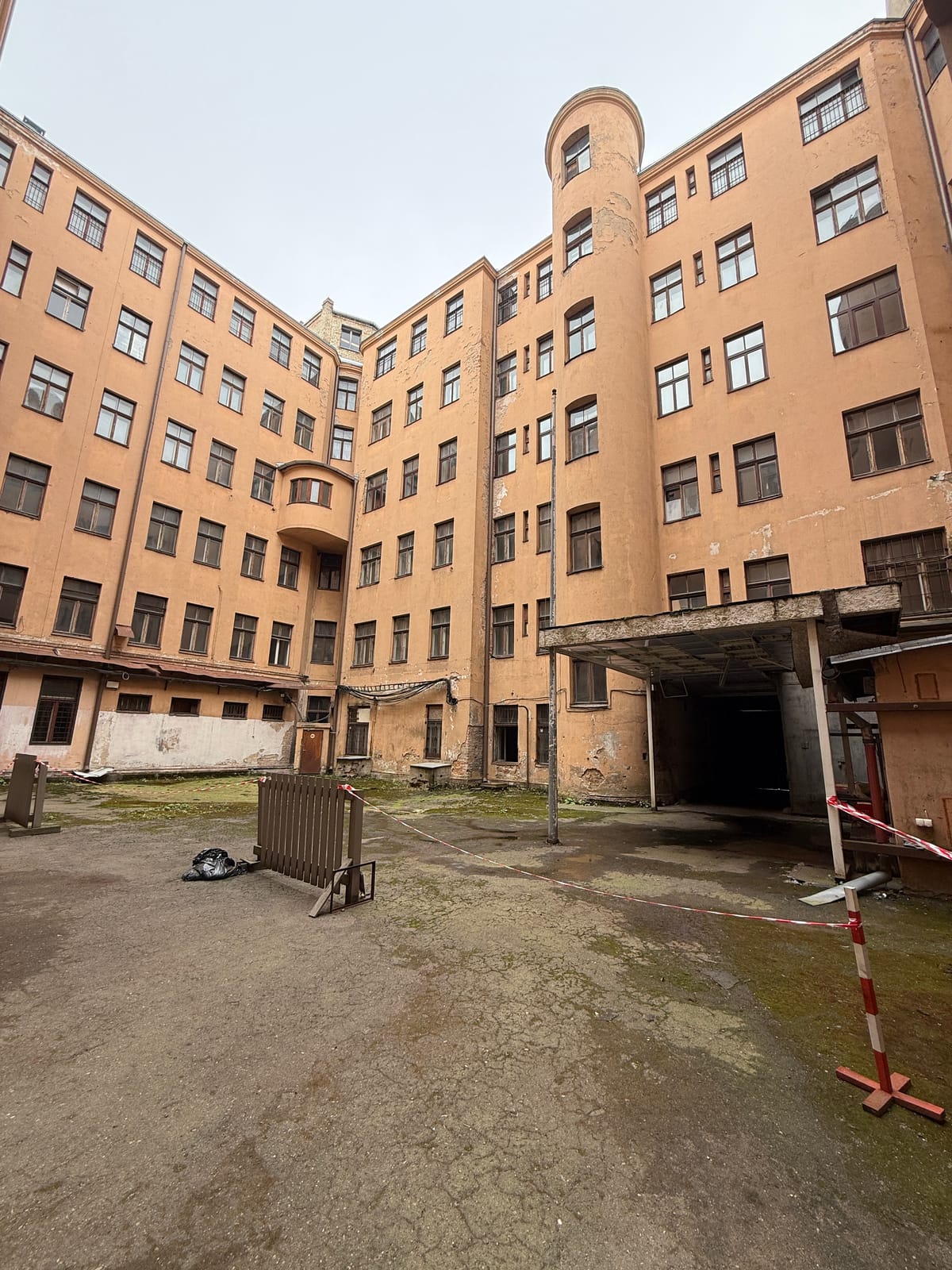
A quiet house on Riga's grandest street
The Corner House stands at Brīvības iela 61, on the corner of Stabu iela, right on Riga's main avenue. The Latvian architect Aleksandrs Vanags designed it, and it was built between 1910 and 1912 in an elegant Art Nouveau style, six storeys around a large inner courtyard. For its first decades it was an ordinary, even grand, address: apartments, a pharmacy, a bookshop, grocery stores, a music school. In the years of the first Latvian republic the state used it too, among others the Ministry of the Interior through the 1920s and 1930s.
Latvians simply call it the Stūra māja, the "House on the Corner". The plain nickname became a euphemism for something everyone understood and no one wanted to name. That is what makes the place so unsettling: a house like any other, on a street full of life, turned into the centre of a machine built to terrorise a nation's own citizens.
Three occupations in five years
To follow what happened here, it helps to hold the timeline. In the space of five years Latvia, independent since 1918, was occupied three times. In June 1940 the Soviet Union marched in and annexed the country. In July 1941 Nazi Germany drove the Soviets out and occupied Latvia in turn, until 1944. Then the Red Army returned, and the second Soviet occupation lasted until independence was finally restored in 1991.
Both the Soviet and the Nazi regimes were brutal for Latvia, each in its own way. This house, though, tells the Soviet half of the story: it was the headquarters of the Soviet secret police during the first occupation and again, for almost half a century, during the second.
1940 to 1941: the first Soviet year
In June 1940 the Soviet Union occupied Latvia. Within weeks the NKVD, the Soviet secret police that Latvians called the Cheka and that later became the KGB, took over the Corner House. Floors of flats became offices and dozens of cells. Around 200 people could be held at once, and at times the cells were packed far beyond that.
The building was engineered for control. A special lift with a lockable compartment carried prisoners upstairs out of sight. The staircases were lined with wire mesh so no one could jump. Interrogations happened in a windowless room on the ground floor: a single desk, a truncheon on it, and a mirror that hid an observation chamber behind the wall. Prisoners scratched messages into the cell walls. In the hallway stood a wooden box where ordinary people dropped written denunciations of their neighbours and colleagues. Fear was not only inflicted here, it was collected here.
In the small courtyard a narrow exercise pen survives, its top sealed with iron grilles so nothing could be thrown in or out. Visitors call it the tiger cage.
This first year is remembered in Latvia as the Baigais gads, the Year of Terror. It ended with its largest crime: on the night of 13 to 14 June 1941, 15,424 people were deported from Latvia to Siberia in a single operation, whole families, including children under ten. The target was deliberately the country's teachers, officers, officials and professionals, its backbone. Of those taken that year, roughly a third to 40 percent did not survive exile, the journey or execution.
The execution room
During that first Soviet year, prisoners were shot inside the building itself. A panel in the execution room names 30 people killed there between January and June 1941 alone. The bullet holes are still in the wooden panelling, each one now marked, and in one corner there is a drain in the floor. Outside, a truck was left running so the noise of its engine would cover the gunshots, then the bodies were loaded into it and driven away.
1941 to 1944: the Nazi occupation
In July 1941 German forces drove the Soviets out and occupied Latvia. When they entered the Corner House they found the bodies of prisoners the retreating Soviets had shot, and used the discovery for propaganda. The Nazi-appointed Latvian self-administration and a collaborationist youth group took over rooms in the building.
The German occupation was its own catastrophe for Latvia, even though its worst crimes did not take place in this house. Within months almost the entire Jewish community of Latvia was murdered, around 70,000 people. In the Rumbula forest on the edge of Riga, some 25,000 Jews were shot over two days in late 1941, one of the largest single massacres of the Holocaust before the death camps. German units carried it out, helped by local collaborators. We name it here so the period is not glossed over: these were two totalitarian occupations, not one villain and one rescuer. What the Corner House itself preserves, in its cells and its execution room, is the record of the Soviet terror that came before and after.
1944 to 1953: the Stalin years
When the Red Army returned in 1944, the Corner House became the headquarters of the Soviet security service again, and the hardest years began. Tens of thousands of people were arrested. Across the countryside, armed partisans known as the Forest Brothers fought on for years, and the security police hunted them from desks in this building.
The terror peaked on 25 March 1949. In Operation Priboi, around 42,000 people were deported from Latvia in cattle wagons, mostly farming families who refused to give up their land to the collective farms, together with anyone suspected of helping the resistance. More than 5,000 died in exile, and survivors could begin to return only after 1956. These mass deportations were planned from here, and across the occupation the security police opened some 48,000 criminal cases for "anti-Soviet" offences.
By now the shootings had been moved out of the building, to Riga Central Prison or to Moscow, and the old execution room was altered. In one of the coldest details of the whole house, that room was later turned into a kiosk where staff could buy cigarettes. After Stalin's death in 1953 the worst of the terror eased, but the KGB went on watching from this address until 1991.
The people behind the numbers
Many of the totals from these years are only estimates. But some numbers are exact, and those are the ones that stay with you: the 15,424 of a single June night, the 30 names on the execution-room wall. It helps to hold on to individuals too. The Latvian poet Knuts Skujenieks was held here, accused of "anti-Soviet" activity. When he returned to the building many years later, he asked for one simple thing: to see the cell where he had been kept.
The museum's guides say visitors often fall silent, and some break down in tears, because they or their parents or grandparents passed through these rooms. This is not distant history in Latvia. It is one or two generations back, in almost every family.
Visiting the Corner House today
The house stood empty after the KGB was dissolved in 1991, and the Latvian police used it until 2008. In 2014, when Riga was a European Capital of Culture, it finally opened to the public, and since 2015 the Museum of the Occupation of Latvia has run an exhibition here on the history of the KGB in Latvia.
The ground-floor exhibition is free. To see the cells, the tiger cage and the execution room you join a guided tour of about an hour, which you should book ahead because places fill quickly. Children under 12 are not admitted to the tours. On the Stabu iela side of the building, a memorial called "The Black Threshold", a half-open steel door by the artist Glebs Pantelejevs, has remembered the victims of the KGB since 2003.
The Corner House sits right in the centre, a short walk from the Old Town and from our own residences, so it is easy to fit into a day in the city. It is a heavy hour, but we think it is one of the most important things you can do in Riga.
Why we take our guests here
We almost always bring the people who stay with us to the Corner House. Not because it is pleasant, but because you cannot understand Latvia, or this corner of Europe, without it.
Three things stay with you. First, that the terror was not chaos but administration: lifts, wire mesh, filing cabinets, a box for denunciations, a truck to hide the sound. A normal building in which a state processed its own citizens. Second, that freedom is not a given. Latvia only regained its independence in 1991, and standing in these cells you feel how recent and how fragile that is, especially in this region, especially now. And third, that behind every number is a person, a family, a cell with a name scratched into the wall.
A word on language, because it matters. The people who ran this house were the Soviet totalitarian regime and its security police: the Cheka, the NKVD, the KGB. It was a system, not a nationality. Latvia suffered under two totalitarian occupations in those years; this house keeps the memory of the Soviet one. Remembering it clearly is the whole point of keeping the doors open, so that it is never repeated.
Opening hours, tickets and guided-tour booking at the Museum of the Occupation of Latvia.